
Posted by The Office Furniture Experts on Nov 24th 2026
Training Room Furniture: Flip-Top Tables, Nesting and Stacking Chairs
Training room furniture comes down to five decisions: which layouts the room needs to support, what size flip top tables fit those layouts, whether your chairs should nest or stack, how power reaches the people at the tables, and where everything goes when the room is cleared. Answer those in order and one room can host onboarding Monday, a workshop Wednesday and a company lunch Friday. Skip one and every reset turns into a half hour of dragging furniture into a hallway.
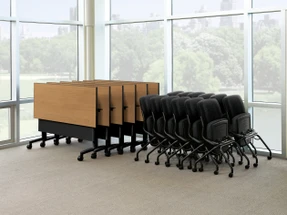
Training rooms work harder than they used to. In 2026 the same space handles new hire orientation, hybrid certification sessions, sales kickoffs and the occasional all hands. That's why the furniture has to move. This guide covers each decision, the measurements worth checking, and the flip top tables, nesting chairs and stacking chairs we carry, so you can plan a corporate training center, a classroom or a multipurpose room with confidence.
THE SHORT ANSWER
- Plan for at least two layouts. Most training rooms switch between classroom rows and a U-shape or group pods.
- Choose flip top tables that nest. A top that flips vertical lets tables roll together and store in a fraction of their footprint.
- Use 24" deep tables for most training. They fit a laptop and notebook. Go 30" deep for heavier computer work, 18" for lecture style seating.
- Nesting chairs roll, stacking chairs stack. Nest if the room resets often, stack if storage space is tight.
- Bring power to the tables. Ganging, modesty panels with cable troughs and freestanding power keep cords off the floor.
STEP 1: PLAN THE LAYOUTS FIRST
Before you pick a single table, list every way the room gets used. A lecture with a presenter up front needs a different setup than a workshop where small groups build something together. Most rooms need two or three layouts, and the furniture should make switching between them easy.
Training Room Layout Guide
| Layout | How it works | Best for | Rough space per person |
|---|---|---|---|
| Classroom | Rows of tables facing the front | Lectures, software training, certification | 18 to 22 sq ft |
| U-shape | Tables on three sides, open end at the screen | Discussion led sessions, small groups of 12 to 25 | 25 to 35 sq ft |
| Pods or clusters | Groups of 2 to 4 tables pushed together | Workshops, breakouts, team exercises | 20 to 30 sq ft |
| Boardroom | Tables ganged into one long surface | Meetings and reviews in the same room | 20 to 25 sq ft |
| Theater | Chairs only, tables stored | Town halls, presentations, events | 8 to 10 sq ft |
Use those numbers to check capacity before you order. A 900 sq ft room seats about 40 to 50 in classroom rows, closer to 25 in a U-shape, and nearly 100 theater style with the tables put away. Keep main aisles at 44" wide and side aisles at least 36", and leave 6' to 8' between the front row and the screen. If the math gets complicated, our team offers planning and design services to lay it out with you.
STEP 2: CHOOSE THE RIGHT TRAINING TABLE SIZE
Training tables are narrower than desks on purpose. They pack more people into a room and still give everyone room for a laptop, a binder and a coffee. Most come in standard widths and depths, so sizing is mostly about the work people do at them.
Training Table Size Guide
| Table size | Seats | Good fit for |
|---|---|---|
| 48" x 24" | 1 to 2 | Small rooms, individual work, tight floor plans |
| 60" x 24" | 2 | The most common training table size |
| 72" x 24" | 2 to 3 | Larger groups, boardroom setups when ganged |
| 60" or 72" x 30" | 2 | Computer training, dual monitors, drafting |
| 60" or 72" x 18" | 2 to 3 | Seminar and lecture seating, note taking only |
Pick one size for the whole room when you can. Matching tables line up cleanly in rows, gang into a straight boardroom surface and nest together in storage. Mixing depths makes every layout a little uneven.
STEP 3: WHY FLIP TOP NESTING TABLES WIN
A fixed top table on casters can move, but it still takes up its full footprint when stored. A flip top table tilts its surface vertical with a lever, then rolls into the table behind it. Ten tables that cover 100 sq ft of floor in use can store in a corner.
Here's what to check on a flip top training table:
- The flip mechanism: one handed or dual lever releases make resets faster. Look for a lock that holds the top flat under weight.
- Locking casters: tables should roll easily during a reset and stay put during a session.
- Modesty panels: they block the view under the table, and many include a cable trough for power and data.
- Ganging hardware: connectors hold tables together so rows don't drift apart.
- Durable tops: high pressure laminate with a sealed edge holds up to daily moving and cleaning.
Flip Top Training Tables We Recommend
The HON Flip Top Nesting Table is a 60" x 24" table that links into training rows, groups into a conference table or works on its own as a workstation. The Safco Flip-N-Go Training Tables use dual sided levers to flip the top quickly, and their integrated modesty panel includes a built in cable trough for power.
For rooms that reset several times a week, the SitOnIt Ocala Flip Top Training Table sets up in seconds: the surface flips up and locks for use, then breaks down with a single pull. The Special-T Transform-2 Flip Top Training Table is built for rooms where every inch counts, and the Special-T Link Flip Top Training Table is designed to connect into collaborative setups and nest for storage.
Want to choose your own size? The AMQ Concur Training Table comes in three base sizes that fit six top surfaces, with a modesty panel. For multipurpose rooms and church or school halls, the National Public Seating Flip-N-Store Training Table has a blow molded polyethylene top that's light and easy to clean. Browse every option in our nesting and training tables collection.
STEP 4: NESTING CHAIRS VS. STACKING CHAIRS
Both chair types clear a room fast. The difference is how they store and how much effort the reset takes.
Nesting chairs have a seat that flips up so the chairs roll into each other in a line. Most have casters, which means one person can push a row of ten across the room. They're usually more comfortable for full day sessions, with mesh backs and contoured seats.
Stacking chairs stack vertically, often four to ten high, and many go on a dolly. They take up less floor space in storage and usually cost less per seat, so they're a smart pick for theater style events and rooms with a small storage closet.
Nesting vs. Stacking Chairs
| Feature | Nesting chairs | Stacking chairs |
|---|---|---|
| How they store | Seat flips up, chairs roll together in a row | Stack vertically, often on a dolly |
| Reset speed | Fastest, no lifting | Fast, but chairs have to be lifted |
| Storage footprint | Medium | Smallest |
| All day comfort | Usually higher, often mesh with casters | Good for shorter sessions |
| Best for | Training rooms that reset weekly or daily | Events, overflow seating, tight storage |
STEP 5: TRAINING CHAIRS WE RECOMMEND
People sit in training chairs for hours, not minutes. Look for a breathable back, a seat that doesn't dig in by early afternoon, and casters that suit your floor. Arms help in long sessions but need to clear the table, so check arm height against the table's underside.
| Chair | Type | Why it works in a training room |
|---|---|---|
| AIS Stow Training Chair Quickship | Nesting | Designed to fit 95% of body shapes and sizes, flip up seat, casters for quick setup, quick ship |
| AMQ Tizu Training & Nesting Chair | Nesting | Contemporary mesh design that moves between training, conference and group spaces |
| Global Spritz Nesting Armchair | Nesting | Translucent elasticized mesh back in colors that coordinate with Global textiles |
| Element Flex Nesting Chair | Nesting | Tensioned pivot mesh back and gliding seat for comfort in long sessions |
| OM Seating YS70N Flip-Seat Nesting Chair | Nesting | Rolling flip seat design that nests efficiently, pairs with the YES series |
| Friant Soleil Nester | Nesting | Folds and unfolds easily, smooth glide casters even when folded |
| HON Ignition Multi-Purpose Stacking Chair | Stacking | Stacks four high and comes with casters for quick rearranging |
| SitOnIt Focus Mesh Back Stacker | Stacking | Versatile mesh back side chair for training, reception and cafeterias |
Short on floor space for tables? A tablet arm chair like the Offices To Go Training Room Tablet Arm Chair gives each person a writing surface without a table at all. And for flexible setups, the Friant Lune Nesting Table with Soleil Nesting Chairs Bundle pairs a mobile table with two matching nesting chairs in one order. See more in stacking and nesting chairs.
STEP 6: POWER, PRESENTATION AND STORAGE
Power. Training rooms run on laptops, and a full day session will drain every battery in the room. Tables with cable troughs can be ganged and powered together. For tables that move, freestanding power modules and clamp on power modules bring outlets and USB to the table without drilling.
Presentation. Put the screen on the short wall so rows face it straight on, and add a mobile whiteboard for breakout groups. Our room dividers and presentation boards can also split one large room into two sessions.
Storage. Measure the closet or wall where furniture will go before you order. Nested tables need about as much depth as their top is wide, plus a little for the flipped surfaces.
PLAN YOUR TIMELINE AND BUDGET
Several brands we carry, including AIS, offer quick ship versions of popular training chairs, so a room refresh doesn't have to wait months. Larger table orders and custom laminates take longer, so plan a few weeks ahead of a launch date. Budget for the whole room: tables, chairs, ganging hardware, power, presentation boards, delivery and installation. We offer free shipping and white glove installation on qualifying orders, and our specialists will build a customized quote for one training room or a full training center. As we covered in how much it costs to furnish an office in 2026, commercial grade furniture bought once almost always costs less than light duty furniture bought twice.
FREQUENTLY ASKED QUESTIONS
What is a flip top training table? A table whose top tilts vertical with a lever so it can roll into other tables and store in a small space. Most have locking casters and a modesty panel.
What size training table is most common? 60" x 24" is the most common size. It seats two people comfortably with room for laptops.
What's the difference between nesting and stacking chairs? Nesting chairs have flip up seats and roll together in a row. Stacking chairs stack vertically. Nesting chairs reset faster, while stacking chairs take less storage space.
How many people fit in a training room? Allow about 18 to 22 sq ft per person in classroom rows, 25 to 35 sq ft in a U-shape and 8 to 10 sq ft for theater seating.
How do you power a training room with mobile tables? Gang tables together with cable troughs, or use freestanding or clamp on power modules that move with the tables.
PLAN YOUR TRAINING ROOM WITH A REAL SPECIALIST
The right training room depends on how often it changes and who's using it. At OfficeChairsUSA, you'll talk to a real furniture specialist, not a chat bot, who can plan your layouts, size your tables, match chairs and quote one room or an entire training center. And we're still a phone call away after your furniture arrives. Call us at 888.355.4999 or browse all nesting and training tables and stacking and nesting chairs to get started.