
Posted by The Office Furniture Experts on Aug 17th 2026
The World's Most Ergonomic Chair: The HAG Capisco
The HAG Capisco is a saddle-seat ergonomic chair built around active sitting — it lets your hips open, your spine hold its natural curve, and your body shift positions all day instead of freezing in one static posture. That constant, low-effort movement is why ergonomists consider active seating one of the most effective ways to reduce the musculoskeletal strain that comes from a normal 8-hour workday at a desk.
If you've spent any time researching ergonomic seating, you've probably come across the HAG Capisco — that distinctive saddle-shaped chair that looks more like something from a design museum than a typical office chair. It's not a gimmick. Designed by Norwegian ergonomist Peter Opsvik and honored with the Norwegian Design Council's Classic Award, the Capisco was built around a simple idea: sitting still all day is the problem, not the chair. Below, we break down exactly what makes the Capisco different, the ergonomic benefits it delivers, and why "active seating" as a category is worth taking seriously for your team's long-term health.
What Is Active Seating?
Active seating refers to any chair or stool designed to keep your body gently moving while you sit — engaging your core, shifting your hips, and encouraging small postural adjustments — rather than locking you into one fixed position for hours at a time. Instead of a rigid backrest and armrests that box you in, active seating gives your body room to rock, lean, swivel, and reset itself throughout the day.
The idea is grounded in a straightforward piece of physiology: your spine, discs, and muscles aren't designed for prolonged stillness. Movement keeps blood flowing, keeps muscles engaged, and prevents the stiffness and load buildup that comes from holding one posture too long. Traditional office chairs are built to support stillness. Active seating is built to support motion.
What Makes the HAG Capisco Different
At first glance, the Capisco's saddle seat is the most obvious departure from a conventional task chair — but the real engineering is in how the whole chair responds to your body.
The saddle seat opens your hip angle. Sitting on a traditional flat seat compresses your hips into roughly a 90-degree angle, which rounds the lower back and puts pressure on the spine. The Capisco's saddle shape opens that angle closer to 135 degrees, similar to how you'd sit on a horse or a bike. That open hip angle lets your pelvis tilt forward naturally, which helps your lower spine keep its healthy "S" curve instead of collapsing into a slouch.
The Balanced Movement Mechanism keeps you in motion. Rather than a single recline point, the Capisco's mechanism moves with you as you shift, lean, or twist, so you're never anchored to one static position. Small, continuous movements like this reduce the static muscle loading that leads to fatigue and stiffness.
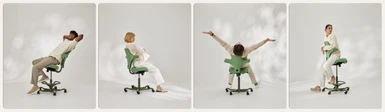
It's designed to be sat on more than one way. Sit facing forward, sit sideways, sit backward with your arms resting on the backrest, or perch on the edge like a stool. That versatility is intentional — it means you can change your working posture throughout the day rather than being locked into a single position for hours.
It adjusts to fit real bodies, not an average one. Seat depth, back height, tilt tension, and seat height are all adjustable, and the Capisco is available in multiple height ranges — including a sit-to-stand version and a stool-height version — so it works whether you're at a standard desk, a standing desk, or a drafting table.
The Ergonomic Benefits of the HAG Capisco
Better spinal alignment. The open hip angle and dynamic seat pan support the spine's natural curve instead of fighting against it, which is a core reason ergonomists recommend saddle seating for people who deal with lower back discomfort from prolonged sitting.
More core engagement. Because the seat doesn't lock you in place, your core and postural muscles stay lightly active to keep you balanced — similar to sitting on an exercise ball, but with far more back and structural support.
Improved circulation. The sculpted aluminum base includes a foot-rest ridge, and the open hip position reduces the pressure on the back of the thighs that a flat seat can cause — both of which support healthier blood flow during long stretches of sitting.
Genuine flexibility across workstyles. With three height configurations (16.5"–21.5", 19"–26", and 22.5"–32"), the same chair can serve a standard desk, a height-adjustable desk, or a standing-height workstation — useful for teams that use sit-stand desks and want a seat that keeps up.
Built to last. Every Capisco carries GREENGUARD Gold certification for indoor air quality and a 10-year (or lifetime, on the Capisco Puls) warranty, so the investment in better sitting doesn't need to be repeated every few years.
Why Active Seating Is Best for Overall Workplace Health
The case for active seating isn't just about comfort — it's about what happens to the body over years of desk work. Prolonged static sitting is consistently linked to lower back pain, reduced circulation, muscle deconditioning, and the afternoon fatigue that chips away at focus. Research on active workstations and dynamic seating points to a consistent pattern: seating that encourages small, continuous movement helps offset those effects by keeping muscles engaged, supporting healthier posture, and reducing the pressure points that build up during static sitting.
There's also a cognitive angle worth noting. Movement increases blood flow — including to the brain — and many ergonomists and occupational health researchers connect that increased circulation to better alertness and sustained focus later in the day, compared with staying rigid in one position. For teams doing focused, sustained knowledge work, that's not a small thing.
Active seating isn't meant to replace movement breaks, standing desks, or good workstation setup — it's meant to complement them. A chair like the Capisco works well alongside a sit-stand desk specifically because it doesn't force you to choose between sitting and standing; it gives you a middle range of active postures in between.
Who the HAG Capisco Is Best For
- Sit-stand desk users who want a seat that transitions smoothly between sitting and standing heights.
- Drafters, engineers, and lab or bench workers who need a chair that performs at counter height, not just desk height.
- Anyone dealing with lower back discomfort from long hours in a traditional flat-seat chair.
- Multi-posture workers — people who lean over a monitor, twist to a second desk, or want to angle toward a colleague without fighting their chair to do it.
- Facilities managers outfitting hybrid or flexible workspaces, where one adjustable chair needs to work across several desk heights and users.
HAG Capisco vs. HAG Capisco Puls: Which One Fits Your Space?
Both chairs share the same saddle-seat philosophy and Balanced Movement Mechanism, but they're built for slightly different needs:
The original Capisco (8106/8107) uses a fully upholstered seat and back with a broader range of high-end finish options — a strong fit for executive offices, conference spaces, or anywhere the chair needs to match a more polished aesthetic.
The Capisco Puls uses a molded shell with a fully upholstered seat cushion, comes in a range of shell colors, is easier to clean, and sits at a lower price point — making it a popular choice for labs, classrooms, collaborative spaces, and larger multi-seat deployments where budget and durability both matter.
Both are available in standard, sit-to-stand, and stool-height configurations, so the deciding factor usually comes down to finish, budget, and how heavily the chair will be used.
Frequently Asked Questions
Is the HAG Capisco good for back pain? Many users find saddle-seat chairs like the Capisco helpful for lower back discomfort because the open hip angle supports the spine's natural curve instead of encouraging a slouched posture. It's not a medical treatment, but it's a widely recommended ergonomic tool for people who sit for long stretches.
What is active seating, in simple terms? Active seating is any seat designed to keep your body gently engaged and moving — through an open hip angle, a dynamic mechanism, or an unstable base — rather than holding you in one fixed position for hours.
Can the HAG Capisco be used at a standing desk? Yes. The Capisco is available in a sit-to-stand height range (19"–26") specifically designed to pair with height-adjustable desks, so you can perch or sit at standing height as well as seated height.
Is the Capisco hard to get used to? There's a short adjustment period for most people, since it moves and sits differently than a traditional chair. Most users adapt within the first week or two and find they don't want to go back to a fixed seat.
What's the difference between the Capisco and a kneeling chair or balance ball? Unlike a balance ball or basic kneeling chair, the Capisco offers full back support, adjustable height and depth, and a mechanism engineered for all-day office use — giving you the movement benefits of active seating without sacrificing back support or long-term comfort.
Find the Right Active Seating Setup for Your Team
Choosing an ergonomic chair isn't a one-size-fits-all decision — it depends on desk height, how the space is used, and how each person actually works. That's where our team comes in. At OfficeChairsUSA, we skip the chat bots and guesswork: you'll talk to knowledgeable furniture experts who can walk you through Capisco vs. Capisco Puls, help you figure out the right height configuration for your desks, and get samples and quotes moving fast. Reach out to our team to find the active seating setup that fits your workplace.